Snow Leopard

Snow Leopard
Snow Leopard cub (7 mos old) - Cape May County Zoo

Sunday, March 31, 2013

Bunnies are Cute....

..but they do require a lot of care! 


This is the time of year when people think it might be cute to get their child a bunny. It is worth considering the "cost" before you make a decision based on emotion.

While rabbits are cute and can make excellent pets, there are some caveats and things to consider.

1. Is this rabbit going to be inside or outside (in a hutch)?

2. Are you aware of the proper feeding requirements of a rabbit?

3. Are you aware of the proper habitat (be it in or out) for a rabbit?

4. Are you prepared for veterinary expenses? 

5. Is there a veterinarian in your area that sees rabbits (not all vets do!)?

A great resource for rabbit owners and those interested in rabbits is The House Rabbit Society.  

Some caveats from my personal experience:
-they don't live that long overall - 6 to 7 years, with a rare 10-12 year old
-once they get sick - or rather, show YOU that they are, they decline rapidly and fairly often, die even with treatment
-they can be aggressive (see my comment below)
-if not handled properly, they can literally break their back, leading to the need for euthanasia
-some need to have their teeth trimmed every 4-6 weeks by a vet

FYI..*I* do see rabbits for medical and surgical conditions. Spaying and neutering of rabbits is also often recommended for behavioral and medical reasons. 


Thursday, March 28, 2013

Tiger Gets New Surgery

A novel way of eliminating pain is to remove the "signal" pathway. In the case of Tacoma, the 13 year old Siberian tiger this means cutting the nerves that "tell" his brain his aging hips hurt.  


Thursday, March 7, 2013

Meet Tama

This is too cute and heartwarming NOT to share!

Check out this story about a cat and a Japanese train that, well, saved each other.

Feline Station Master Tama

PS. I love the ailurophilia going on in that nation!


Tuesday, February 26, 2013

Use it ALL or CALL!

It has come to my attention recently that people have been doing all sorts of things with medications and their pets.

Here are a few examples:

1. Using meds from another pet in the household

2. Having "leftover" antibiotics for the same patient for the same problem

3. Using medications from a friend's pet

4. Using medication here and there, a few days at a time or whenever "x" happens (red ear, diarrhea, etc you name it!)

Ok, there are NUMBER of problems with these situations.

First of all, you should NEVER have "left over" antibiotics unless one of two things has occurred

 A. Your pet had a problem with them and you called your vet for a NEW or different medication to treat the problem

 B. Your vet gave you a second round of them because he/she knows it's a recurrent problem and understands you KNOW how that when it recurs you are to give the entire second course as directed

B is not usually a problem - because those cases/clients are familiar to us and "get it." A however, is a HUGE problem. People stop giving medications for all sorts of reasons, never call us to discuss it and then return 2 weeks to 6 months later to tell us that "Gee, doc the problem never got better." AND sometimes they are upset about it!! Yes, really! We do answer phone calls and we don't even charge for that! 

No antibiotic or anti fungal - be it topical or oral - should be used here and there. It's for a certain course or length of time to kill the bacteria or yeast in that location. Even if your pet seems to be doing better, by stopping early you are in essence breeding more resistant forms of bugs for the next go round. 

All I can say is PLEASE follow the instructions and if there are any issues or concerns, PICK up the phone and call your veterinarian. YOUR vet. Your VETERINARIAN. Not your groomer, Aunt Susie, your neighbor, etc.

We do know a thing or two after 8 years of school and many years of in the field practice and most of us are more than happy to help and if we don't know, can find out for you! 


Friday, February 15, 2013

Turtle Medicine

Ok, I freely admit this is NOT from my personal case files. It is from a colleague that I work with a few days a week.

So this turtle had an abscess.  The pictures below best show it:


Here is a good link for turtle owners: http://www.boxturtlefacts.org/Ear_Infections_in_Chelonians.pdf

What was very cool was seeing the doc give propofol INTO the sinus and slowly watching the turtle go to sleep. FYI, reptiles do everything slowly including heal.

But what was needed was to open this up and flush it out. So once the sedation had taken effect, this is what the outcome was:


Saturday, January 26, 2013

I See Chickens Too

Yes,  I see chickens as patients too. I don't generally do birds, but by "birds" I really mean what are classified as Psittacines - parrots and the like. I never saw enough of them to feel very comfortable doing the best for them or their owners. I would of course, on an emergency basis but most people who have these birds - if they seek veterinary care - want and deserve someone who does a LOT of bird work.

I love raptors too but I rarely get the chance to work on them either. I did a little at a few jobs and in my time at the Cape May Zoo.

I am very familiar with chickens, however. This is because of my time at the Univ of Delaware - and not just because we ARE the Fighting Blue Hens. Delaware is a huge poultry producing state - both eggs and meat. There is a lot of research at the University regarding poultry health and nutrition, as well as related topics like agricultural methods, environmental impacts, etc. 

I did research as an undergrad in poultry nutrition and I loved it. I also helped a few grad students with other topics like poultry immunology, etc. It was here that I learned what I now use to treat the occasional chicken that comes in to my office.

The chickens I see are often pets. They may be used for eggs but overall they are truly dearly loved and very sweet to work with.  


This is a sweet girl named Buffy who was attacked by a beagle one morning that had gotten out of his owner's property. She came in with multiple lacerations to the left hind end - thigh and very close to the vent (which is the shared GI, urinary and reproduction - egg laying - outlet).  

She was in stable condition but needed some wound cleaning and closing. Due to the discomfort she was experiencing we used gas anesthesia to sedate her and cleaned up the wounds. One involved muscle so I sutured that up as well as closed most of the skin. Fortunately there was not a lot of tension on it. And also fortunately, the vent was untouched and in tact. Her tail feathers were torn off and the the tail head itself was shredded pretty  bad but we got it back to a pretty normal anatomy. 

Here are some immediate post op pics:


We sent her home on some injectable antibiotics that we showed her owner, a knowledgeable pet parent, how to give. 

This is her one week later and all the sutures are still there and the tissue appears to be healing very nicely.  She is enjoying a pampered life at home in a very protected area and is apparently the envy of the other chickens in the flock!


Friday, January 25, 2013

Important Info!

I'm sharing a list put out by the AVMA on some of the top poisonous HUMAN drugs that our pets may ingest and the harm they can cause.

Please, keep your medications out of the reach of your pets. You may not understand it (frankly, I don't) but they sometimes will eat them, no matter what they taste or look like! 

Check this out:  10 Poison Pills for Pets


And if your pet does eat these or any other human medications, please call YOUR veterinarian (not your neighbor, the breeder, your uncle, your hairdresser, etc). If it's after hours, call an emergency veterinary center in your area.

AND please - PLEASE - call us BEFORE you give any medications we didn't prescribe. We will talk to you about things over the phone if you are a client. Please don't give something for 3 weeks and then call to see if it's ok! Dogs are different than humans and cats, well, they are a whole different animal! 


Monday, January 21, 2013

A Long Awaited Answer

Now that the holidays are behind us, we can get back to learning and experiencing life in the world of veterinary medicine.

I posted a picture of a dog's skin toward the end of last month, asking readers to take a guess as to what was going on.  I didn't get any responses but I won't take that personally - I know it was a busy time of year AND I've been away from the blog for a bit.

Well, here's what's going on with that dog. That dog happens to be MY dog, a 4 yr old Golden Retriever named Theo. 

Theo has hydrocephalus which is explained at the link. We don't know whether it was congenital or not, but we do know he was normal at 9-10 months of age.  

He began exhibiting restlessness at about 2 1/2 - 3 yrs of age. Sedatives did not help his condition. The MRI was the definitive diagnosis and the reason he was put on the medications he was on and they have helped tremendously. He is not a 100% "normal" Golden and probably never will be, but he has come a long way.

He was on a low dose of steroids, which are used to treat a wide variety of neurologic conditions in animals. Dogs and people tend to have more issues with long term steroids than our feline friends, who do quite well with them. 

Theo developed a rare condition called calcinosis cutis, which IS what it sounds like - calcium deposits in the skin. It can be quite irritating. 

The photos were pretty classic or as we say in veterinary medicine - pathognomonic for this disease. I sent photos of Theo to my favorite local dermatology vet - Dr. Brian Palmeiro, VMD and he agreed it was likely that. We needed a few skin biopsies to determine 100%, so I performed those in my office and yes, it was indeed that. 

Now we are weaning him off the pred slowly - SLOWLY - that's the key. Why? Well, when we give dogs or cats (or people) steroids, we shut down the pituitary adrenal axis pathways for these being produced naturally in our bodies. If we simply stopped cold turkey, our bodies would go into shock! We need steroids, so to let the adrenal glands get back up to production mode, we slowly wean off the prednisone. Fortunately, it's the phenobarb that's helping with most of the neurologic signs AND I have to have him possible evaluated for surgical drain placement, which might mean no meds are needed down the road.


Saturday, December 22, 2012

What is this?

Ok, I have a few pictures to show you. I will tell you this about it. The pictures are of the skin of a 4 year old Golden Retriever. He has a brain condition which required him to be put on long term phenobarbital and prednisone. The neurologic issues resolved with medication. Approximately 6 months after the medication was started, this happened:


The lesions are hard and crusted. The hair that is attached easily pulls off. There is some itching/discomfort associated with it but overall the dog is doing well - happy, eating, etc.

This WAS biopsied and so we do have a definite diagnoses.

Any thoughts or further questions?


Sunday, December 16, 2012

A Few Lessons in This One

I realize what *I* commonly see, may be "weird" or "rare" or frankly, SHOCKING, to most of you.

One of the most common things I see is dogs or cats with late stage cancer that were showing no signs until the day or two before they came into my office. Sometimes, thankfully rarely, people ignore signs like weight loss, lethargy, vomiting and inappetence and let it go for months. Though THAT does happen. It saddens me because there are times we can help those pets.  

We have to remember our pets often deal with pain and disease better than we do. It's truly part of their "predator" nature to hide illness. Or else they could become "prey."  It's truly amazing what processes animals are going through and yet they continue to eat and greet us as happily as ever.


But remember, we too can have things going on that no doctor in the world could see and often we have tests that are negative or normal while severe disease rages on inside. 

The other day an older German Shepherd came in (7 years) for being lethargic and a distended abdomen. The owner noticed this. Now, because I know what I know and do what I do, one of the top things that came to MY mind - breed, age, signs - bleeding splenic tumor. This is very common in our GS, Goldens and Rotties as they get older. I've seen dogs come in fine and they went out for  a run and collapsed because the bleed was fast. I've seen dogs I've examined and palpated come back in 3 months later with a mass that was NOT there before. 

This is how cancer works - in us and them.

So this dog needed some tests to confirm this and also to see how good of a surgical candidate we were - always possible for other diseases to be going on AT the same time. Dogs, cats and people can live just fine without a spleen.

Other questions:
1. Was there any evidence of spread (namely to the chest)?
2. How anemic was this dog (do we need a blood transfusion)?

Dogs can have benign or malignant splenic tumors. The only way to know is to remove the spleen and send tissue to the pathologist. The most common cancer is hemangiosarcoma.

The dog was moderately anemic (not in need of a transfusion) and the x-ray confirmed a bleeding mass with loss of detail on the image in the area of the spleen. An ultrasound was done to check for any spread to the liver (other types of cancer would do that - mast cell, lymphoma).   

We do these things to see what kind of surgical candidate the dog is AND to help the owner make the most educated decision possible.  This is a serious surgery and they can die from secondary cardiac arrhythmias, blood clots, etc. 

So, we take the dog to surgery and this is what we see:


What you see is a big mass on top of the spleen, a smaller one off the front edge and then hundreds of little red/brown masses all over the omentum, and I mean, ALL over. There are more than what is even in this picture. 

This was not going to be visible on any other test other than..bingo: an exploratory surgery. Sometimes the best test is using your eyeballs! 

There was evidence that some of these "little" spleens had started to grow and bleed out. There was NO way this was resectable. The owner was notified and chose to humanely let the dog go while she was sleeping. No other choice really. The kindest but hardest one. 

We thought we could fix this one. We couldn't. We didn't know until we got in there. This is what happens sometimes. 

Thursday, December 6, 2012

Belated Answer


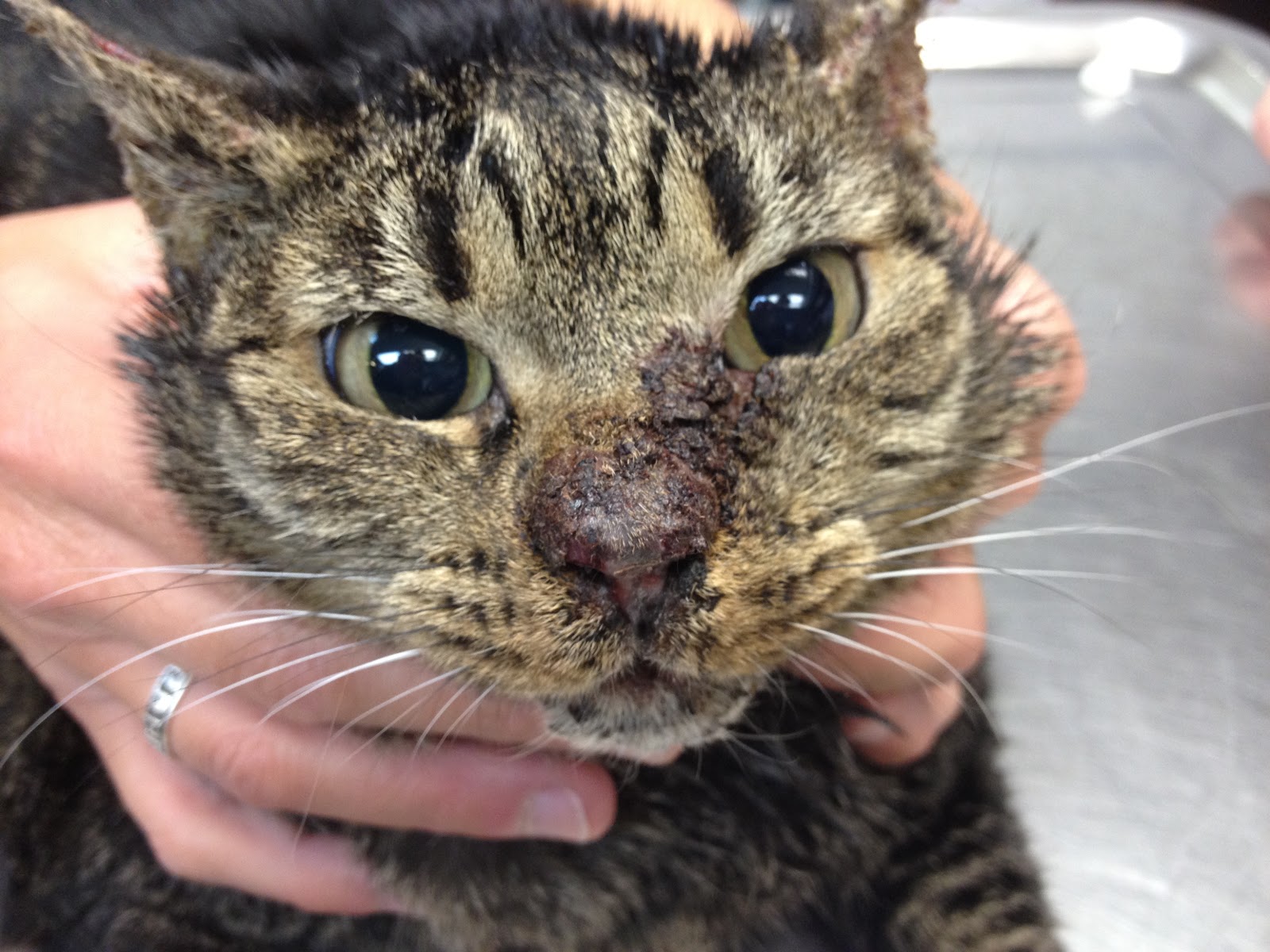
This is another picture of the same cat's feet a month or two later.  I'm not sure if you can truly appreciate how crusted and thickened the toes/feet are. This was present on all four feet. I cannot imagine this would be very comfortable for kitty. I didn't have a second picture of the face/ears but suffice it to say it was much worse and the cat was now clinically not doing well. She was losing weight and not very active. This, despite steroids.

So what is this?

Well, ONLY a biopsy of the affected tissues would tell us but the most likely two differentials, given the lack of response to typical skin medications, the severity of the disease and the progression to affect overall health are:

1. Autoimmune disease

2. Cancer (neoplasia)

We do see cancers that present ONLY as generalized skin disease. It's not as common as other types of cancers in pets. Cutaneous lymphoma is a "more common" one seen in dogs.  

Also, other types of cancer can result in skin disease from the suppression of normal immune system function.

Autoimmune diseases are a group of conditions where the body attacks itself. In this case, the immune system is OVER doing it's job!  These are often treated with high (or immunosuppressive) doses of steroids. This cat didn't respond AT ALL to the steroids. However, there are cases where other, more potent medications are required. These often carry with them more serious side effects, so we would never want to just give them without a confirmed diagnosis.

The owner had declined biopsy from the beginning due to cost and so we will never know. The cat was euthanized the day I took this picture due to her poor and declining quality of life.  She was 5-6 years of age. 

Sunday, November 18, 2012

Another quiz!


This 5-6 yr old spayed domestic short hair kitty presented to me as a sort of 3rd opinion a few months ago.

She had this skin condition (also on her feet) that had been going on for a little bit. The other vets had tried the usual antibiotics and a steroid injection to no avail.

She lived inside and was otherwise "healthy."

Any guesses on what this COULD be?


Saturday, November 3, 2012

A Pre Holiday Warning

This time of year brings a spike in certain types of cases, many of which are preventable. One of the biggest illnesses we see is pancreatitis.

Here  is a link to a quick Q&A with a vet on this condition.

Please know that even a "little" of something can make your pet very sick, even IF they have had it in the past.

I recall an 11 yr old Golden Retriever that came in after Thanksgiving one year and had to be hospitalized for days for getting a small piece of turkey. He had some in past years. He almost didn't make it. Once the pancreas starts releasing digestive enzymes into the surrounding tissues - it's not only painful but very possibly fatal. This is no joke.


Monday, October 15, 2012

The Answer


Yes this dog had a urethra FULL of stones - from where it exits the pelvic canal to just before the "os penis" - which is, yes, a small bone IN the penis of male dogs and a great area for stones to lodge (the urethra cannot expand as it passes through this U shaped little bone.)

What was even more amazing was this dog somehow could still pee and had a small bladder. Of course he was very uncomfortable.

In cases like this we try to flush the stones back into the bladder where it's much easier to extract them. This is unlikely in a case of this severity and indeed, the surgeon had to open the urethra up to get some of them out. This is tough because it's already a small tube and can very easily stricture or get much narrower if sutured so we often leave it open to heal with a little time. They do quite well. In the meantime, the dog urinates out of the little hole there.  

This dog is doing very well post - op!

PS. For the person with the answer of a constipation issue : that never "presented" itself and was never an issue after surgery. However, your assessment on the radiograph was not wrong. 

Saturday, October 13, 2012

Another Quiz


Can anyone tell me what's wrong with this dog? And what can we do to help him?


Tuesday, October 9, 2012

Your Cranky Old Cat

Of course it's always good to get scientific evidence but this makes sense and seems logical. All of us, no matter the species, age as do our brain cells.  


We already recognize "Cognitive Dysfunction" in dogs - aka "doggy Alzheimers." So I am not surprised we find it in our felines too.


CHECK THIS OUT

Sunday, October 7, 2012

Answers

Excuse me if I"m a little tipsy..a bit sugared out from my wonderful experience as a judge in the Pocono Cupcake Wars. Oh the things one must endure. But hey, it was a dream come true.

I'll throw in a nice happy, non sick or disgusting pet photo from today!


Yesterday, Sue correctly guessed it was Feline Leukemia and FIV (or "kitty AIDS") Snap test that shows a Leukemia positive.

The top blue dot (think 12 o'clock) should always be present. It's the control dot and means the test ran correctly. There should be no other dots. One at 3 o'clock is FELV, one at 9 o'clock is FIV. And yes, you can have both.

This test takes just 10 mins and 0.1 mls (a VERY small amount) of blood to run in your veterinarian's office. It's recommended for any NEW cat - kitten or adult and for sick cats, even ones that were previously tested. 

This cat was not well and was a feral cat in for a neuter and release type situation. Shelters are already FULL to overflowing and there are few homes or places that will take in a FELV + cat. This disease is spread by casual contact between cats. There is an effective vaccine against it. However, many people have multiple cats and may not want to vaccinate their whole "herd" to take a positive cat in (unless they have cats that go out too - in which case they REALLY should be vaccinated anyhow.)  In addition, feral or unfriendly cats, are not the easiest to adopt. There are already (very sadly) a ton of sweet healthy kittens and cats that need homes.


Saturday, October 6, 2012

A Quick Test


What is this? Does anyone know? And what does it tell us?


Wednesday, September 19, 2012

WHAT Did That Pet Eat?

Each year, a publication called Veterinary Practice News, puts out the word, looking for the most unique things radiographed inside our pets.

Even us vets find this stuff amazing and fascinating. You never know what an animal will eat (and it's not just dogs and cats - reptiles and other small pets are included too.) Often times, the owner doesn't even know!

Check it Out!!

Friday, September 7, 2012

Cuterebra

It's that time of year when we see certain conditions in pets.

One of the big ones right now is fleas. We are seeing a lot of pets with fleas - even "indoor" kitties. There are great products out there folks. Ask your vet what they recommend. Remember, flea collars AND fleas are often found on the pet simultaneously - i.e., they are a waste of money.

But one of MY personal favorite things is Cuterebra.

From the Merck Veterinary Manual Online:

This opportunistic, parasitic infestation of dogs, cats, and ferrets is caused by the rodent or rabbit botfly, Cuterebra spp (order Diptera, family Cuterebridae). Flies are usually host- and site-specific relative to their life cycle. However, rabbit Cuterebra are less host-specific and are usually associated with dog and cat infestations. Rarely, cats and dogs may be infested with Hypoderma spp or Dermatobia hominis . Ferrets housed outside may be infested by Hypoderma or Cuterebra spp .


Now typically we see these in cats and rabbits. But the other day a an older dog came in for a lump.Of course since it was older, the most common thing would be...a lump. Whether it was of concern or not had yet to be determined. My technician told me it was on the front leg (inner side of area by carpus or wrist area). He said it was soft. So, I'm thinking its possibly a lipoma (benign fatty mass).

I get in the room and see this:


One look and I knew..it was something I love..and an easy fix for the dog. The thing in the center is the larva.  So all we had to was pull it out, intact and flush the wound. Send the dog home on antibiotics and it would be fine! No need for surgery -which is good - she was 16yrs old and a diabetic!


Where did she get this? She plays near and in a pond. There were a lot of flies in the area according to her owner. 

Don't worry. I rarely see this in dogs or even cats. If it happens, it's easily dealt with. In fact, if you don't remove it, it will fall out in a month, pupate and become a fly. A wound with a very regular circular edge would remain leaving you wondering what happened. Sometimes people assume the pet got shot.