Snow Leopard

Snow Leopard
Snow Leopard cub (7 mos old) - Cape May County Zoo

Saturday, September 10, 2011

Info for Pet Owners AND Vets Alike


Yes, this will affect you if you are an American and reading this! It doesn't matter if you have a pet or not! It doesn't even matter if you are a small business owner (like the majority of veterinarians) or not. If you are breathing, it WILL affect you!


I urge you to attend (it's FREE!) if you are anywhere near the Lehigh Valley or watch on live streaming video if you are not!


Friday, September 9, 2011

The Two Faces of IMHA

IMHA = Immune Mediated Hemolytic Anemia


In other words, for some reason, the body is attacking and breaking down it's own red blood cells (RBC's), resulting in variable levels of anemia and potentially death.


The past few weeks, I have encountered two cases of IMHA without apparent cause. I say this because we do know that sometimes, granted rarely, it can occur as a sequelae to vaccinations. This usually happens with certain vaccines and/or if there are multiple vaccines given but generally within a week or so of them being administered.


Both of the patients I am referring to had no vaccines, were not on any medications and as far as the owners know, did not get into anything.


It can be spontaneous and idiopathic (meaning we simply don't know the root cause). This is especially true in Cocker Spaniels who are over represented as a breed for this condition.


Not in my 2 cases. One was a young Chihuahua, one was a middle aged Shih Tzu.


The Chihuahua is doing great on our standard treatment of prednisone at immunosuppressive doses. We need to stop his body from attacking his own cells. We can start to wean him down and monitor his PCV (packed cell volume). He may be fine on no pred, low dose pred or may crash and relapse. There is NO predicting with this condition.


The second patient, a Shih Tzu, is not so lucky. She had 2 blood tranfusions and was put on 3 medications to help (by another animal hospital) before I even saw her. She came in with her PCV already starting to drop. She declined further by the next day and I knew she needed to get sent to the internal medicine specialists. They gave her a 20% chance with everything they could give her and a few thousand dollars. The owners felt that owed the cute little dog that much as she had been there for the young lady through thick and thin of life and love. I would have done the same - 20% is not 0%!  So far, she's with us, but it doesn't look good. 


This disease frustrates us as it is often so unpredictable, and like regulating a diabetic, often an "art" in knowing when to change dosages, etc. 


Sometimes the only symptoms are vague ones - the dog is a little off, a little "lethargic" etc. This is why I never ignore an owner's concern about changes in their pet's behavior. You shouldn't either.

Thursday, September 8, 2011

Simply Tragic

This is a news story I found that just made me go :(


It's one of those things that just happens and no one is to blame. But it's sad, nonetheless.


Dolphin shows to resume at Brookfield Zoo after accidental death of one of them


Dolphin shows at the Brookfield Zoo are scheduled to resume today after a female dolphin died after apparently colliding with another dolphin minutes before a show Monday.
Nea, a 4-year-old Atlantic bottlenose dolphin, was set to perform an afternoon show when the accident occurred, officials said.

Preliminary results of a necropsy indicated she sustained a fractured skull, according to a press release issued by the Chicago Zoological Society, which manages the zoo.

The incident happened just before the 1 p.m. show.  Marine mammal staff heard a loud pop and responded immediately, officials said. The staff noticed that the female dolphin appeared injured and trainers jumped into the water and attempted to save her by performing CPR, officials said.

Wednesday, September 7, 2011

This Brings Back Memories

When I was in undergrad, at the Univ of Delaware, my immunology professor, Dr. John Dohms, used to read these cases from the CDC's Weekly Morbidity and Mortality Report. They were often cases involving zoonotic agents (things that can pass from animals to humans) and/or weird cases. I used to love that part of the class.


This case of human rabies in a 70yr old man illustrates just the sort of cases we'd go through. The MMWR, as it's called, is often quite detailed in the history and progression of the case, also offering a summary on what can be learned from it. 


In this case (which supports MY stress on getting and keeping your pets - even "indoor kitties" - up to date on rabies vaccine!),the report states:


This case highlights the variable presentations of rabies and the ease with which a diagnosis of rabies can be missed in a clinically challenging patient with comorbidities. Clinicians should consider rabies in the differential diagnosis for patients with progressive encephalitis or neurologic illness of unknown etiology and caregivers should take precautions to avoid exposure to body fluids. Continued public education regarding risks for rabies virus exposure during interactions with wildlife, particularly bats, is important.

Tuesday, September 6, 2011

The REAL Labor Day!

I don't know how it is for those in other medical fields - you know, all those "real" doctors/specialists out there - but in veterinary medicine, the day after a 3 day weekend is often insanely busy!  It doesn't even seem to matter what the holiday is - though that sometimes dictates the type of cases one sees:
after Christmas and Thanksgiving - a lot of gastroenteritis, pancreatitis, and foreign bodies, Fourth of July - all sorts of injuries among many other issues.


What often happens is that people wait until the weekend is over - if they think they can "make it" until their regular vet opens - so they can avoid paying for an emergency hospital visit, which IS (understandably) more expensive.


The problem is that sometimes, clients wait and they shouldn't and sometimes they could wait and they don't. But it's better to err on the side of caution. 


Today was no exception to the "Tuesday is really gonna feel like a Monday" rule. We started the day off with a walk-in ear/skin problem and a twitching cat that the owner had applied an oft-maligned-by-vets OTC flea product (this is why we hate it!).  


The dog *I* saw - and though the owner stated he had had this problem a short while, a physical exam and my years of experience told me that it was clearly a very chronic issue. So either the client has no idea or he thinks he can get one by me. The exam findings do not lie.  The cat was seen by a colleague and started on standard treatment for this type of toxicity. The cat should be fine but note this: anyone looking to save a small amount of money on a flea product from WalMart needs to think about the hundreds they might spend on treatment for the cat or the flea problem that still will exist. We have excellent veterinary products that are safe AND effective, which is why we recommend them!


From there the day continued on with routine visits and sick pets too, right through lunch with no stopping but fortunately ended on time! At least I was prepared mentally. AND since today it rained and rained and rained all day, I didn't mind being stuck inside so much!

Monday, September 5, 2011

You Named Your Pet What??

Each year, one of the largest veterinary insurance companies, VPI, compiles a list of unusual pet names for cats and dogs.


The link contains photos of these pets but I'll just give you the list:


Dogs
1. Almost-A-Dog
2. Franco Furter
3. Stinkie McStinkerson
4. Sir Seamus McPoop
5. Audrey Shepburn
6. Dewey Decimell
7. Knuckles Capone
8. Beagle Lugosi
9. Shooter McLovin
10. Uzi Duzi Du


Cats
1. Ozzy Pawsbourne
2. Mr. Meowgi
3. Murderface
4. Fuglee
5. Scruffernutter
6. Corporal Cuddles
7. Cat Masterson
8. Spam
9. Tape W. Orm
10. Louisiana Purchase


I do recommend you go to the site though - not only are there pictures but there are stories to go with each name.  


Sunday, September 4, 2011

Diamonds in the "Ruff"

Yes, dogs will and do eat everything!


Check this story out!!


The dog ate my diamonds... Really!

Posted: Aug 22, 2011 4:20 PMUpdated: Aug 29, 2011 12:51 PM

$10,000 worth of diamonds disappeared from a Georgia jewelry store, but they didn't have to go far to find them again. They quickly figured out it was an inside job, and recovered the jewels the next day.
In fact, they didn't even have to call police.
John Ross Jewelers is well-known in town for their four footed mascots. Tiffany and Velvet roamed the shop for years, and appeared in commercials. After their passing, Honey Bun now greets customers and as Chuck and Ann Roberts found out their new pup has expensive taste.
Honey Bun's not much of a guard dog, but is great on customer relations. "He's been loved," says Co-owner Chuck.
Customers sometimes hide treats in their purses for Honey Bun, but the Roberts' recently learned this pampered pooch has more expensive taste. It happened two weeks ago when a customer came in.
"A customer came in, and I jumped up out of my chair and came out here to wait on him, and I left the chair where he could jump up on my chair, and jump up on my desk," said Roberts.
On the desk four packs of loose diamonds, about a carat each to set in diamond earrings, pens, and dog treats. When he returned only three packs remained, and an empty pouch like this one was lying on the floor.
"We looked all over and there weren't any diamonds, so immediately I knew he'd eaten them."
Since Honey Bun wasn't talking, there was only one way to find out.
"She came down and took him across the street and we ran X-rays."
 Carbon doesn't show up on an X-ray, but two blank spots confirmed Honey Bun was a likely suspect. It only took a day, and they found another surprise.


Interestingly they don't say how they "recovered" them but since they didn't mention surgery, I can pretty much guess how..and it involved some washing of said jewels!


Friday, September 2, 2011

Tragedy at Lunch Time

Today was going pretty well. My day started off with a "nursing visit" that ended up taking up an hour of my (aka doctor) time. 


I finally got to start surgery at 10:30am or so and there were not that many, so I was able to get an early and decent lunch break...or so I thought.


I was sitting outside enjoying the lovely day when I see a few people walk in with a dog in their arms. It looked like a puppy and they didn't seem to be in a hurry to get in.  


The other vet that was on today had to run out so she asked me if I could look at a dog that was attacked by other dogs. 


When I walked in the building, one of our healthcare team members had this dog brought down immediately, because she quickly and correctly recognized that this 4 mo old chihuahua puppy was not doing well at all! 


He was clearly in shock and fading fast! His gums were white, his BP was low and he was in respiratory distress. Despite our best efforts of nearly 45 minutes- IV fluids, steroids, oxygen and other drugs to help keep him going - he passed away. His traumatic chest injuries were simply too much for his little body to handle. 


This little dog had crawled into a neighbors yard, where her two dogs saw him as "prey" and grabbed and shook him violently. He had a tear in his chest wall, pneumothorax and subcutaneous emphysema (air under the skin from the compromised chest wall/lungs). 


The owner of the dogs felt bad and did pay his bill, though clearly she didn't do anything wrong by having HER dogs in HER yard. I understand how she felt though and would've done the same thing.


:( What else can I say??

Thursday, September 1, 2011

How the PPACA (aka Obamacare) affects Veterinarians

I do try to keep this blog about animal topics, but I reserve the right, since it is MY blog, to discuss whatever I deem important. 


In this case, I can absolutely tie this announcement to veterinary medicine. You may ask "why?" Well, most of us in veterinary medicine are either small business owners or employees of a small business.  The PPACA does affect us, whether we own a business or not. In fact, it affects EVERY single segment of the US population in some way, shape or form. 


How?


 Well, since many people have not read the actual bill, notably those that passed it, a wonderful group I am involved with as Vice-Chair, The Lehigh Valley Coalition for Health Care Reform, has decided to host an event called Everything You Wanted to Know About Obamacare (But Didn't Know Who to Ask) at DeSales University in Center Valley, PA. For those who don't know, that's  near Allentown, PA.  


Speakers include:
 -Former Rep. John Shadegg on Nuts and Bolts of Obamacare/Timeline of Implementation
-Dr. Nick Pandelidis, Docs 4 Patient Care, on How it Affects Taxpayers, Medicare, Medicaid and the Deficit
-PA State Rep Doug Reichley on How if Affects States and Efforts to Challenge It
-Sam Denisco, Director, Gov't Affairs PA Chamber of Business and Industry on How it Affects Workers, Job Creation and the Economy
-Dr. Richard Armstrong, Docs 4 PatientCare, on How it Affects Doctors, Access To and Quality Of Care
-Dr. Alieta Eck, Pres. AAPS on What Would Be Better Than Obamacare? 


There will also be breakout sessions and a Q&A with our speakers!!


If you are not local, we will have live streaming video the day of the event! 


The Lehigh Valley Coalition for Health Care Reform
proudly presents a free Constitution Day Educational Workshop


Everything You Wanted to Know  About "ObamaCare"
(But Didn't Know Who to Ask)

Saturday, September 17, 2011
1 to 5 p.m.  (Doors open at Noon)

Gerald White Pavilion of the University Center
on the campus of DeSales University
2755 Station Avenue, Center Valley, PA 18034

Expert Presentations, Q&A, Breakout Sessions, Exhibits

Health care professionals, policy experts,
grassroots advocates, and legislative leaders
will explain how the Patient Protection and Affordable Care Act (PPACA),
also known as "ObamaCare," affects every American

Topics include:
The Nuts and Bolts of "ObamaCare"
How "ObamaCare" affects Personal Liberty, Health Insurance, H ealth Care Choice, and the Uninsured
How "ObamaCare" affects Families, Children, and Seniors
      How "ObamaCare" affects Medicare, Medicaid, Taxpayers,                 and the Deficit
How "ObamaCare" affects Businesses, Workers, Job Creation, and the Economy
How "ObamaCare" affects Doctors, Patients, Quality of Care, and Access to Care
How "ObamaCare" affects States
Efforts to Repeal and Replace "ObamaCare" and much more  

This event is sponsored by  
Docs 4 Patient Care ( www.docs4patientcare.org)
Association of American Physicians and Surgeons - AAPS (http://www.aapsonline.org)
The Galen Institute ( www.Galen.org)
Heritage Action for America ( www.HeritageAction.com)
Americans for Prosperity - Pennsylvania (www.americansforprosperity.org/pennsylvania)
The Black Ribbon Project ( www.theblackribbonproject.org)
M.D. News ( www.MDNews.com)
V.S.A.S. Orthopaedics ( www.vsas.com)
New World Aviation ( www.NewWorldAviation.com)
Pennsylvania Chamber of Business and Industry ( www.pachamber.org)
Pennsylvania Commercial Action Network - PA-CAN ( www.pa-can.org)
The Ayn Rand Center for Individual Rights ( www.aynrand.org)
and the
Lehigh Valley Coalition for Health Care Reform
Look for us on Meetup, Facebook, Twitter and LinkedIn! 

Live Streaming Video will be available - check our website for details

FREE and open to the public
Please reserve your free seat online:
or call toll free: 1-888-698-4111 (Line 1)

For more information, email ObamaCareEvent@aol.com
or call 1-888-698-4111 (Line 2)  

  
Please join the Lehigh Valley Coalition for Health Care Reform if you'd like to support ongoing efforts to educate the public and elected officials about the intended and unintended effects
 of the Patient Protection and Affordable Care Act, aka "ObamaCare."

Wednesday, August 31, 2011

Rare Cat Caught On Video

Those of you who know me, know I love felines -notably wild felines.  Many people are familiar with  tigers, lions, cheetahs, and cougars (to name a few), however, there are quite a few wild felids that don't get much attention. Most of these cats are smaller - some similar in size to our house cats.


This is a story about a rare African golden cat.


Scientists capture rare video of elusive African cat


Scientists tracking one of Africa’s most elusive and poorly understood animals say they’ve recorded a rare  and possibly the only publicly released  video of the species in the wild.
The video, recorded by a motion-activated camera placed in a Gabon forest, shows an African golden cat: a shy, medium-sized feline that ducks human contact and lives in hard-to-access parts of central African forests.
“As far as we know, it’s never before been filmed (in the wild) for ... the public domain,” said Luke Hunter, president of Panthera, the conservation group providing most of the funding for the team that captured the video this year.


The footage, photos and other information that the team is gathering  part of an effort to get a population estimate in certain areas of Gabon’s forests  could contribute to a greater understanding of the species. The International Union for Conservation of Nature, which lists the animal as near-threatened, says it is not only infrequently observed in the wild, it is “Africa’s least studied felid.”


Read More and See a Short Video Clip of this Beauty

Tuesday, August 30, 2011

Update on a Miracle and Coughing Dogs

The other day I mentioned a kitten that had pneumonia. Today she was in for a recheck and she is just amazing! She was running all around the room like a devil, looks like she has been grooming herself and is nearly 100% better!


A little blurry I know but they NEVER stay still!!! 


Lately it seems I've been seeing a run of coughing dogs. Most of these are older patients with little exposure to other dogs or a history of boarding/grooming/dog parks, etc. 


In general people, don't seem to take this stuff seriously. These dogs lately have also been larger breed dogs. When I hear that an older dog is coughing, there are two main things that come to mind before I even walk in the door - cardiac (heart) disease/failure or cancer (primary or metastatic). The breed plays some role in which might be #1 vs #2 (ex: Doberman Pinschers have a lot of dilated cardiomyopathy.)


This week, I saw a 12 yr Pit Bull that turned out to have cancer throughout the lung fields, a 9 year old Pit Bull (no the breed doesn't have a predisposition to either of these but see a lot of the breed) that had a very enlarged heart and a significant murmur and then a 9 yr old Lab that had...kennel cough.  Yes, every once in a while, it is something nice and simple!


These were all diagnosed with chest radiographs and in some cases supported by blood work.


If your dog is coughing, call your vet for an appointment!!  


Monday, August 29, 2011

Warning: Pictures May Disturb You

Today someone dropped off a 3 month old kitten that had been attacked by a raccoon.  At first glance, her face had a large scab over it with only one nostril showing.  After we cleaned it up - this is what we saw: 


Yes, it is bad. But she has two things working for her: 
1. youth
2. being a feline 


Being a feline gives her a heads up on healing. Remember those other kitty cases I've shown you?  And as we learned in vet school, if you get two parts of the bone in the same room and it's a cat (or cow) it'll heal. In other words, they overcome quite a lot!  


This kitten does have some obstacles:
1. The one nostril is partially destroyed at this time. What will become of her ability to smell or breath through her nose? Too soon to tell!
2. She will have some type of deformity - to what degree too soon to tell!
3. She must be a rabies suspect until she's passed 10 days. Though if the raccoon was rabid and the bite occurs this close to the brain, she would show signs before 10 days. This is the reason I handle her with gloves. However, should she turn out to have rabies, I still will need and get post exposure vaccinations. You do NOT want to mess around with rabies. 


Our plan: A few days of antibiotics and then some plastic surgery for her. We can't repair it completely as there are large pieces of tissue missing but we can get some things closer together.


I hope to show you pictures as she progresses!


Sunday, August 28, 2011

A Canine War Hero

Just a nice feel good story - glad we are recognizing the animals that help our soldiers out there on the battlefield!


Veteran dog gets full military funeral

By Clifton French (cfrench@wsbt.com)
5:05 p.m. EDTAugust 13, 2011

KNOX – A war hero, Purple Heart recipient and man’s best friend was buried in front of the VFW Post in Knox Saturday.
"I think about her every day," said Neil Burg, commander of the American Legion in Hamlet.
At the VFW post in Knox, it was a full military honor for the funeral of a veteran of both Iraq and Afghanistan. The ashes of Mira, draped with a small flag, were put in a final resting place right in front of the Veterans of Foreign Wars. A 21-gun salute rang out and Taps was played for a final salute.
Mira spent half her life as a bomb-sniffing dog in Iraq and Afghanistan before she retired in Hamlet. A Purple Heart recipient, Mira spent six years in combat and was wounded three separate times. She has a military record that shows numerous acts of heroism, including alerting a group of Marines to a bomb, allowing all five of them to get to safety before it exploded.
"Five men or women get to go home and spend time with their families because they're alive, thanks to Mira," Burg said.
But it was in Hamlet, Indiana where she was able to be a dog. She was adopted by Donald Thomas only a few years ago.
"She was an excellent dog, I couldn't have chosen a better one," Thomas said.
It was in Starke County were she was treated by Thomas and others like a veteran and hero and where she was laid to rest as one.
"I know she's going to be missed. She'll be missed for a good many years by the VFW, the American Legion and the people who knew her and worked with her," Thomas said.
Mira was 12 years old.  Thomas said she died from lung cancer.
Mira was the first dog to be made a member of the VFW in the state of Indiana, and only the second dog in the state to be made a member of the American Legion. This was the first military funeral in Indiana for a dog that served in combat.

Saturday, August 27, 2011

Breed of the Week: Jack Russell Terrier


Energy.  High energy. Those are the first words I think of when someone tells me they have a JRT or we are seeing one as a patient.


Now most of these dogs are very nice and easy to work on if...IF...you can get them to sit still!! Good luck.


They are very sturdy little dogs. They are also considered to be good family dogs, though they can be strong willed so an owner must be the alpha dog or the cutie will take more than an inch with them.


They do not have too many health issues. The main few I've seen are:
1. Luxating patellas
2. Legg Perthes - a degenerative disease of the femoral head


Below is a photo of an x-ray of a Yorkshire Terrier with this:


The femoral head on the left hand side is being destroyed and is not a nice pretty ball sitting in the acetabulum. This causes pain so we went in and removed the femoral head and smoothed the edges of the remaining bone. Remember - this  is really the only orthopedic surgery I do. This is a common condition in toy/small breed dogs and some cats. 


Friday, August 26, 2011

Case Updates

Those of you that regularly read my blog are familiar with these cases but if you are not, I will provide links to the blog/s they were mentioned in along with each one.


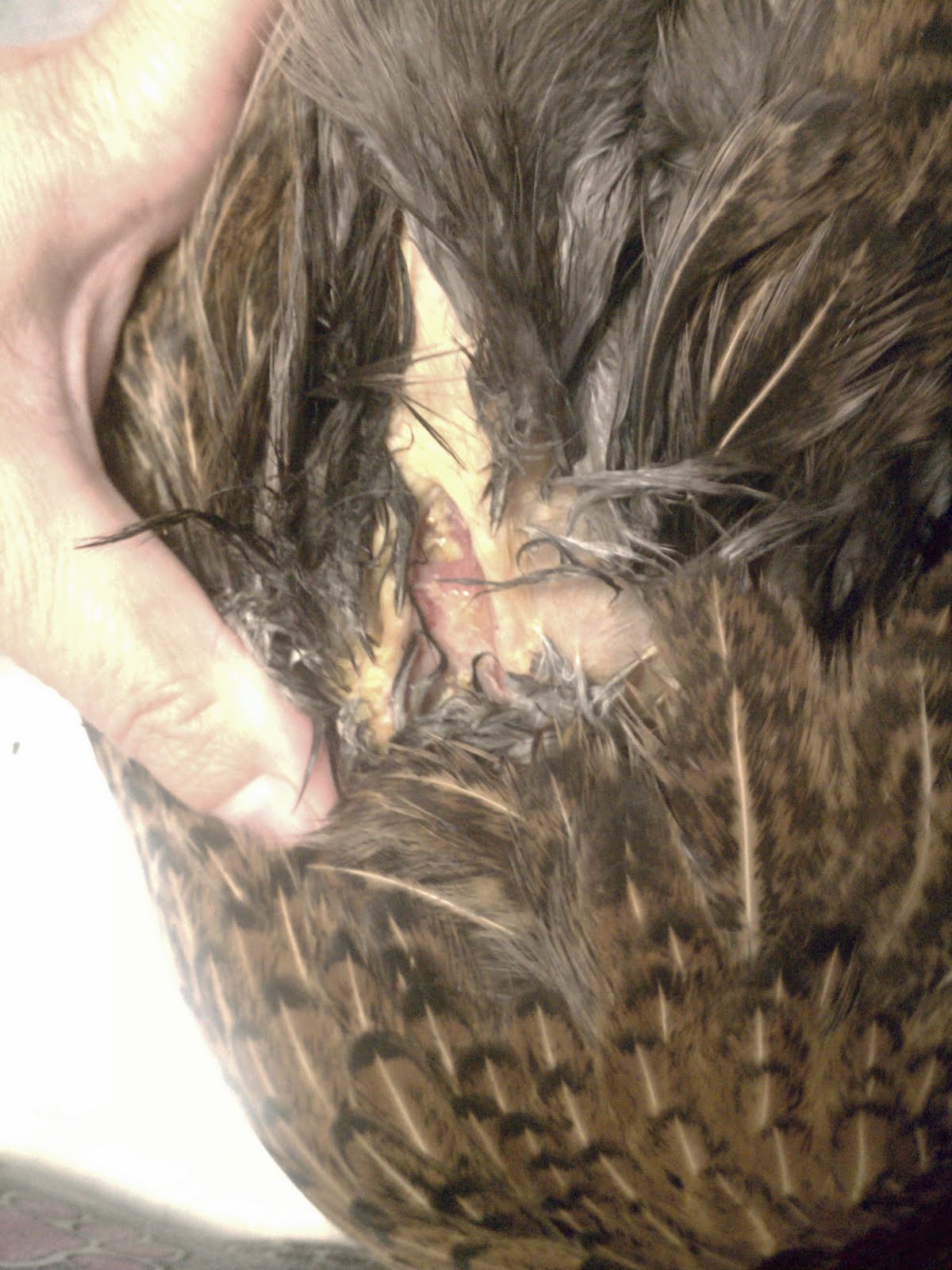
1.  The Americana chicken - "Rosa".  She had a crop infection that ruptured to the outside. It took many weeks and some diligent care on the part of the owners plus a few vet checks, 2 surgeries to close the crop and now the skin is nearly closed over the wound.  The crop has been healed and functioning normally. Throughout this entire episode Rosa has been a sweetheart of a patient. 


The First Blog On Her
The Day of Her First Surgery


Side note: In case anyone is wondering what a crop in a bird is it's a part of the gastrointestinal tract that dilates and stores food prior to digestion.  In the picture below it is the white balloon like object at the front of the bird.


2. The cat with the large gaping wound on her abdomen that we put the drain in last week is doing great! The skin had some tension on it but it is healing. There a few spots that will have to granulate in but overall it's healthy tissue and is not swollen anymore.   We removed her drain today. I'll try to get another picture when she comes in for suture removal.


The Day She Came In


3. I didn't see that I posted this one before, but a cute scraggly little kitty that a very good client brought is doing well after leaving the hospital the other day. She had developed aspiration pneumonia.  The lady found her at a local (and excellent!) restaurant where she works. I told her the kitten had great taste to have climbed on their deck! She's been taking care of her since then - first for an upper respiratory infection and supportive care (force feeding, etc) and now for pneumonia. We don't know how she developed this as she has NOT been force fed for quite some time. But it is always possible she attempted to vomit or did vomit and got something in her lungs. She didn't look too good for a few days even in the oxygen cage with injectable medications.  Still, she's always been a fighter.  


Here's a pic of her I sent to her owner - who frequently texts me with updates.